

Jo Thompson Recruitment contributes to the Report on Jobs, a comprehensive guide on the UK labour market drafted by KPMG and the Recruitment & Employment Confederation (REC), compiled by S&P Global. This monthly report is built upon survey data from recruitment consultancies and employers, providing valuable insights into the latest labour market trends.
Recent data from the UK Report on Jobs, suggests the UK recruitment market may be approaching a turning point. In February 2026, permanent placements edged closer to stabilisation, declining at the slowest pace in nearly three years, with the index rising to 49.2. Demand for staff also softened at the mildest rate in nine months, while temporary billings remained subdued at 48.0. At the same time, continued increases in candidate availability have contributed to easing pay growth, highlighting the shifting balance between labour supply and demand.
Commenting on the latest survey results, Jon Holt, Group Chief Executive and UK Senior Partner KPMG, said:
“Despite a marginal fall in hiring last month, the jobs market was showing its strongest signs of improvement in three years, with hiring at its closest point to turning positive. However, we need stability for sustained growth, and yet again businesses are facing into unexpected economic shocks because of global events out of their control. Resilience is now the new normal, so it is likely we may see these signs of recovery stall again in the near term as chief execs take stock.”
Commenting, Neil Carberry, REC Chief Executive, said:
“There may still be a few bumpy months to come, especially in light of global instability, but the stabilising trend we have seen so far this year has continued. The report suggests that the worst of the hiring slowdown in the UK has passed but it is by no means a source of unalloyed celebration for the South of England where a slowdown in hiring conditions and recruitment freezes means it lags the improving picture in the Midlands and the North.
“A real turnaround requires growing confidence amongst businesses and consumers. There is cash in the system to spend if consumers and businesses feel better – a core goal of policy should be to tackle this by reducing the cost of doing business, which will in turn address the rising cost of living. From a more practical approach to the Employment Rights Act, to energy costs, the impact of business tax rises and planning reform, there is plenty to do that could back businesses to grow and create jobs sustainably.
Executive Summary
The main findings for February are:
Permanent placements fall only slightly in February
Latest survey data indicated that permanent staff hiring decreased only marginally in February, marking the weakest decline since March 2023. While some recruiters mentioned that overall hiring conditions remained subdued, others noted a relative improvement in employers’ willingness to recruit new staff. Meanwhile, temp billings declined modestly in February, following a slight increase at the start of 2026.
Vacancies decline at softest pace since last May
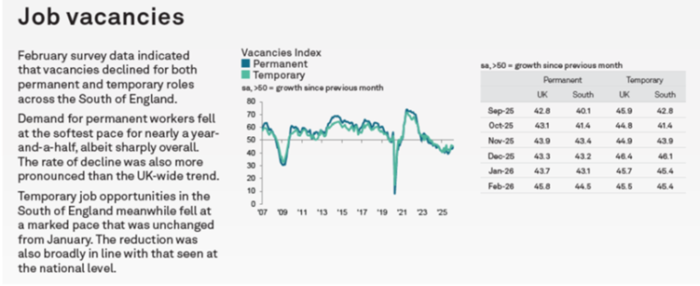
The number of job opportunities across the UK continued to decrease in February. However, the rate of contraction was the slowest recorded since last May, as a weaker drop in permanent vacancies offset a slightly quicker reduction in demand for temporary staff.
Softer increases in rates of starting pay
After hitting a 17-month high in January, the rate of starting salary inflation slowed in February. Notably, salaries increased at the softest pace since last October and to a degree that was well below the survey average. Temp wage inflation also weakened from the start of the year, with pay rising modestly overall. Competition for sought-after skills continued to exert upward pressure on pay, yet some recruiters reported that improved candidate supply had limited wage increases.
Further sharp rise in candidate numbers
February data signalled a rapid rise in overall candidate availability across the UK, with the rate of expansion picking up from January’s one-year low. That said, the pace of increase remained slower than that seen on average over 2025. Underlying data indicated that a stronger rise in the supply of permanent workers more than offset the softest expansion in temp candidate numbers since January 2025.
KPMG and REC, UK Report on Jobs: South of England
February’s insights show permanent placements declining at their fastest rate in nearly two and a half years, alongside falling vacancies, rising candidate availability, and a drop in temporary billings following a brief uplift at the start of the year.
Commenting on the latest survey results Steve Hickman, Reading Office Senior Partner at KPMG UK, said:
“February’s data highlights how South of England businesses are taking a more cautious stance on hiring, with the sharpest fall in permanent placements of any English region. What’s important, however, is that the pace of contraction eased to its slowest for nearly two-and-a-half years – a welcome sign that we may be approaching a turning point as businesses reassess workforce strategies.
“What’s particularly telling is the continued demand for specialists in technology, engineering and professional services, even as overall hiring remains subdued. These persistent skills shortages indicate that growth-focused sectors are still actively building capability and point to where opportunities will emerge as confidence returns.
“At the same time, the region’s softer pay growth – the most modest of all English regions – could actually work in its favour. Combined with rising candidate availability and the region’s established strengths in innovation and professional services, cost-conscious employers have an opportunity to secure talent while competition remains reduced. The question now is whether businesses will seize this window ahead of the new financial year.”
Staff Availability
Steeper increase in permanent candidate availability
The number of people seeking permanent jobs in the South of England expanded at a sharper pace in February. Whilst picking up from January’s 12-month low, the rate of expansion remained comfortably below the average seen over 2025. Where higher staff availability was recorded, recruiters widely linked this to redundancies and reduced hiring activity.
Permanent candidate numbers rose at a similarly sharp rate across the UK as a whole in February.
Growth in temp worker supply slips to one-year low
Adjusted for seasonal factors, the Temporary Staff Availability Index pointed to a slower but still sharp rise in the supply of short-term staff across the South of England in February. Notably, it marked the weakest improvement in availability for a year. Fewer contract roles and company layoffs were linked to the latest upturn. On a regional basis, both the North of England and London saw steeper increases in temp staff supply than the South of England. The Midlands bucked the wider trend and reported a fresh reduction in availability.
Special Feature
This featured article was written by the Recruitment and Employment Confederation
AI and the recruitment industry
Artificial Intelligence (AI) is one of the most talked-about, thought-about, and reflected-upon subjects in today’s labour market. The Recruitment and Employment Confederation’s Topical Questions data from November 2025 asked 234 clients about their use, and planned use, of AI in the workplace, their expectations of skill changes due to AI adoption, and impact these changes may have on our industry.
The data collected showed that 24.3% of respondents were already using AI to enhance business practices. Furthermore, 22.3% were planning to introduce AI into their tech stack within the next 12 months, suggesting that businesses are increasingly recognising how AI can improve workflows and amplify employee capabilities. Research from the REC also found that larger firms (50–250+ employees) are more likely to have adopted AI. Whilst there may be a variety of reasons why smaller firms (0–49 employees) are slower at adopting AI, they must ensure they are not left behind.
Considering the nature of the AI landscape now and the ongoing developments, recruitment firms may feel cautious about the effect that AI will have on hiring. Yet 36.9% of 174 respondents, told us they expected AI to only slightly change existing job roles, predicting that AI will enhance roles rather than replace them. 22.4% of respondents expected there to be a moderate change in the skills and training that roles will require. It is reasonable to anticipate that any skills changes employees will need in adopting AI will be supported by professional development and training, rather than the replacement of employees. This is supported by the data, with 39.9% and 38.7% of respondents respectively reporting that they expect digital literacy and the ability to work with AI to be key skills for employees.
Knock-on effect
The data shows that companies expect AI to enhance, not replace, employees, at least for the time being. With this understanding, recruiters have time to prepare and adapt to the shifts in expectations on candidates who will need to be well-equipped in using AI effectively to succeed in the hiring process.
The adoption of AI is also expected to have a knock-on effect on pay and commission in recruiting practices. In the spring, the REC is expected to publish its latest research on pay and reward in the recruitment industry, which will provide updated salary benchmarks. With the introduction of AI, the way recruiters perform their jobs and the structures of pay are likely to change. In this environment, the importance of professionalism, the human touch and a consultative relationship with recruitment experts becomes even more critical.
What we can do for you:
As recruitment shifts towards skills-based, evidence-driven hiring, relying solely on CVs or intuition is no longer enough. At Jo Thompson Recruitment, we partner with Saville & Holdsworth (SHL) to bring scientific, predictive assessments into your hiring process — from behavioural and cognitive profiling to competency-based evaluations that reveal true potential.
For HR and hiring managers, this means faster, smarter decisions, reduced risk, and hires who genuinely align with both role and culture. By integrating assessment insights into your recruitment strategy, you can elevate quality of hire while strengthening your employer brand.
Discover how JTR and SHL assessments can transform your hiring process — connect with us today to explore a more objective, skills-based approach that drives results.
To talk about how Jo Thompson Recruitment can help you with your resourcing needs, please email us at info@jtrltd.com or give us a call at 01635 918955 for more details.