

Jo Thompson Recruitment contributes to the Report on Jobs, a comprehensive guide on the UK labour market drafted by KPMG and the Recruitment & Employment Confederation (REC), compiled by S&P Global. This monthly report is built upon survey data from recruitment consultancies and employers, providing valuable insights into the latest labour market trends.
July’s data points to a more constructive labour market, with permanent placements stabilising nationally for the first time after a 45-month downturn and temporary recruitment continuing to grow. At the same time, candidate availability remains elevated and employers continue to manage uncertainty and costs carefully, meaning the recovery is still tentative and uneven.
Commenting on the latest survey results, Callum Licence, Group Head of Advisory, KPMG UK and Switzerland, said:
“The July results suggest businesses are beginning to press ahead with investment and hiring, particularly through flexible temporary work. The stabilisation in permanent placements is an important milestone, but employers are still looking for greater confidence that policy and economic conditions will support longer-term commitments.”
Maxine Bligh, Recruitment and Employment Confederation’s Chief Membership & Innovation Officer, said:
“The REC’s view is that the labour market is showing early signs of recovery: temporary vacancies have risen for the first time in two years, temporary billings have increased for a fourth consecutive month, and permanent hiring has stabilised. The next step is to build business confidence and reduce the cost and uncertainty that can hold back hiring.”
Executive Summary
The Report on Jobs is unique in providing the most comprehensive guide to the UK labour market, drawing on original survey data provided by recruitment consultancies and employers to provide the first indication each month of labour market trends.
The main findings for July are:
Permanent placements stabilise and temp billings rise for fourth straight month
The latest survey data pointed to a clear improvement in UK hiring trends at the start of the third quarter. Permanent placements stabilised in July, ending a 45-month period of decline, although demand for permanent staff remained subdued amid political and economic uncertainty and higher labour costs. At the same time, temporary billings increased for a fourth consecutive month, supported by project starts and employers’ preference for flexible workforce arrangements.
Rates of pay growth improve in July
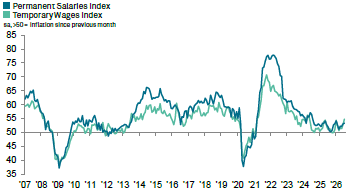
Pay trends strengthened across the UK. Starting salary inflation reached its highest rate in six months, while temporary wage growth hit a 26-month high. Recruiters continued to report competition for suitably skilled and experienced candidates, although permanent salary growth remained well below the long-run trend.
Candidate numbers rise at softer but still sharp rate
Candidate availability increased again in July, extending the current period of growth to 41 months. The overall rate of expansion eased to its lowest level since February, with both permanent and temporary candidate numbers rising more slowly than in June. Redundancies and a lack of job opportunities remained key drivers of increased staff supply.
…as demand for workers continues to weaken
The rise in candidate availability continued to coincide with weaker demand for staff, but the pace of decline improved. The Total Vacancies Index rose from 45.1 in June to 47.1 in July, indicating the slowest fall in vacancies for 22 months. Temporary vacancies increased for the first time in two years, while permanent vacancies fell at a slower rate.
Staff Availability
Overall candidate supply rises at softer but still sharp rate
At 59.8 in July, the seasonally adjusted Total Staff Availability Index signalled a sharp increase in candidate numbers for the 41st consecutive month, although the rate of growth eased to its lowest since February. Both permanent and temporary candidate availability increased more slowly than in June.
Further marked growth of permanent labour supply
There was another steep rise in permanent candidate availability during July, although the rate of growth eased to a five-month low. Recruiters linked the increase to redundancies, concerns over job security and a lack of demand for staff and work opportunities.
All areas of England recorded growth in permanent labour supply, with the North of England seeing the sharpest upturn and London the slowest.
Softest upturn in temporary candidate numbers since May 2023
The supply of temporary workers increased again in July, extending the current period of growth to more than three years. While the increase remained sharp, it was the softest since May 2023. Recruiters linked higher candidate numbers mainly to redundancies and fewer job opportunities. The South of England recorded the fastest rise in temporary labour supply of the four monitored English areas.
Pay Pressures
Starting salaries increase at quickest rate for six months
Permanent starting salaries rose again in July, with the rate of inflation reaching its highest level since January and remaining solid overall. Recruiters often reported that employers were willing to raise offers to secure candidates with the right skills and experience, although salary growth remained well below the long-run trend.
Temp wage inflation hits 26-month high in July
Temporary pay rates increased for an eighth consecutive month. The rate of wage inflation accelerated to its fastest pace in more than two years, with stronger demand for short-term staff and competition for particular skills pushing up pay. The strongest increase was recorded in London, although all four monitored English areas saw higher temporary wages.
Courtesy of IHS Markit, KPMG, and the Recruitment & Employment Confederation
Data compiled July 2026 Source: Office for National Statistics via S&P Global Market Intelligence
KPMG and REC, UK Report on Jobs: South of England
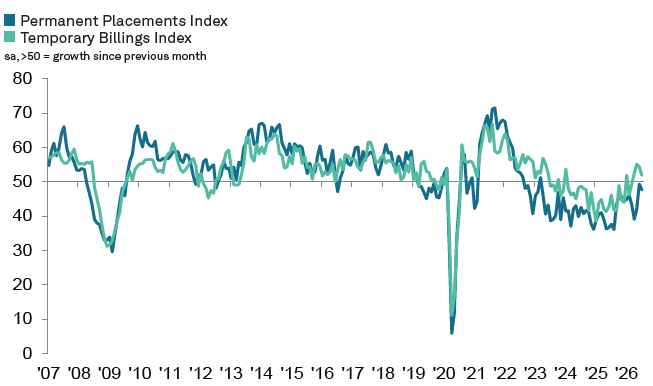
Across the South of England, the July picture remained mixed. Permanent placements fell for a 40th consecutive month, with the index at 47.6, although the pace of decline was the second-weakest of that long period. Temporary billings rose for a fourth successive month to 51.8, but growth slowed to a four-month low. Vacancy declines also eased, while candidate availability remained high, reinforcing a market where employers continue to favour flexibility and where skills shortages persist alongside a growing pool of available workers.
David Williams, Bristol Office Senior Partner at KPMG UK, said:
“The South is showing tentative signs of improvement, but businesses remain cautious about permanent hiring and are increasingly using temporary staff to keep projects moving while managing uncertainty around costs and the wider economy.”
“The regional picture also highlights a persistent skills mismatch. Shortages remain in areas including hospitality, healthcare, cyber security and IT, while the rise in candidate numbers is not translating into easier recruitment across every sector.”
Courtesy of IHS Markit, KPMG, and the Recruitment & Employment Confederation
Staff Availability
Permanent candidate availability in the South of England increased sharply again in July, with the rate of expansion easing to a three-month low. Supply has now risen continuously since March 2023, with recruiters frequently linking the latest increase to redundancies and fewer work opportunities.
South sees fastest rise in temp labour supply of all English areas
Temporary staff availability increased sharply in July, although the pace of growth slowed from June. Even so, the South recorded the fastest rise of the four monitored English areas, with recruiters linking higher candidate numbers to reduced job availability, company layoffs, low employer confidence and higher costs.
Pay Pressures
Starting salaries increase slightly
After falling marginally in June, permanent starters’ pay increased in July. The rise was only slight and remained much slower than the historical average, with the South recording the softest salary growth of the monitored English areas. Some employers were prepared to raise offers for high-quality candidates, while higher candidate numbers and cost concerns constrained overall pay growth.
Stronger rise in temp pay
Temporary wages in the South rose solidly and at an accelerated rate in July. The pace of wage inflation was the second-quickest of the past 14 months, behind April 2026, with competition for particular skill sets cited as a key driver.
Special Feature
This section features analysis from S&P Global’s tri-annual Business Outlook survey for the UK.
UK business confidence weakens despite signs of labour-market improvement
The latest S&P Global UK Business Outlook survey, conducted in June, found that firms’ expectations for the year ahead had weakened amid political uncertainty, inflation, weak consumer confidence and geopolitical risks. The net balance of firms expecting business activity to increase over the next 12 months fell to +26%, from +36% in February, its lowest level since February 2025.
Businesses also anticipate significant cost pressures. Firms expect staff costs to rise at a net balance of +68% and non-staff costs by +56%. These pressures are feeding into more cautious recruitment plans, even as July’s Report on Jobs shows that permanent placements have stabilised and temporary hiring remains resilient.
Overall employment expectations were broadly unchanged at -1%, but the picture differed by sector: manufacturers anticipated an increase in staff numbers of +8%, while service providers expected a slight reduction of -3%.
The survey also found that investment intentions were being constrained by the cost outlook, with capital expenditure expected to fall by 9% and research and development spending by 12% over the coming year.
There were still areas of opportunity. Both manufacturers and service providers anticipated potential benefits from AI-related products and services, greater overseas demand and business diversification, although global trade disruption, domestic policy changes, overseas competition and skills shortages remained risks to performance.
Taken together, the July labour-market data and the June Business Outlook survey suggest a market that is improving in activity but remains constrained by confidence and cost pressures. Employers are beginning to move forward with projects, particularly through flexible hiring, but a broader recovery in permanent recruitment will depend on greater certainty.
The key message for employers and recruiters is that flexibility remains central to the recovery. Temporary hiring is providing a route to progress projects while limiting longer-term commitments, while scarce skills continue to command stronger pay despite a large overall pool of available candidates.
For recruiters, this environment rewards adaptability: providing flexible workforce solutions, accessing specialist skills and aligning closely with sector-specific demand will be important as confidence gradually improves.
If you’d like to discuss your current recruitment requirements or discover how we can help you attract, assess and retain the very best talent, we’d be delighted to hear from you. Call us on 01635 734975.